

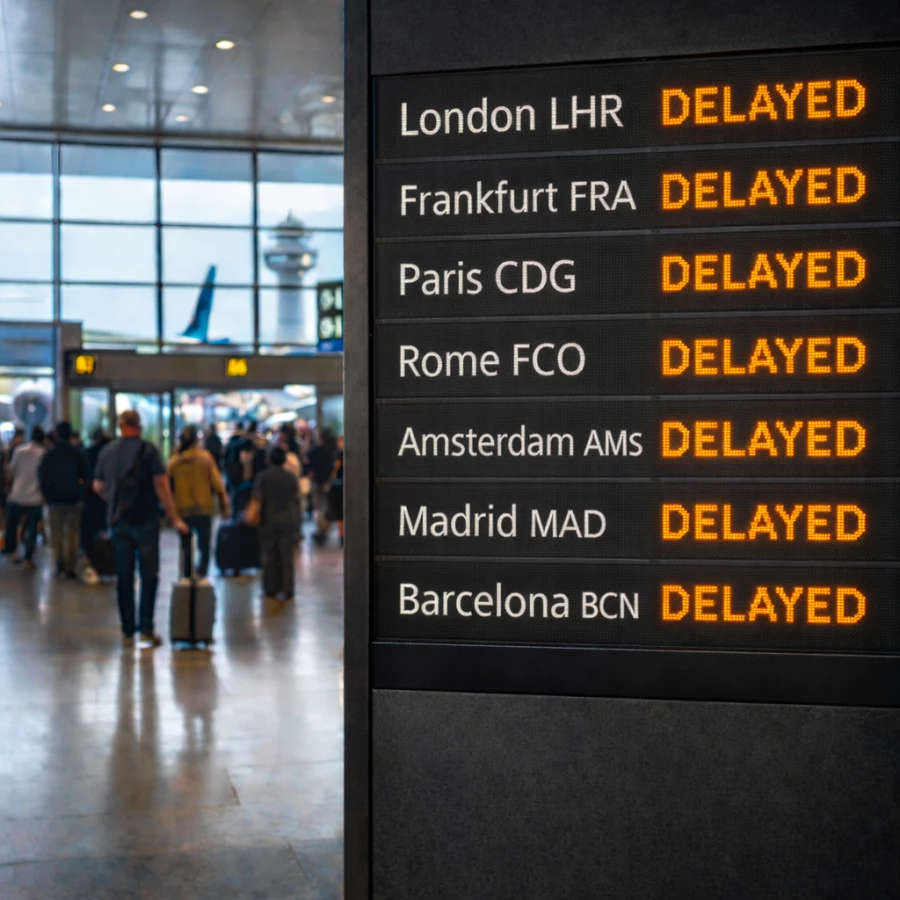
Delayed, Rerouted, Disrupted: What Happened to Air Travel?
Air travel is now such a normal part of life that many people barely think about what happens behind the scenes of a flight. Yet almost every traveler has asked similar questions at some point. Why are delays so common? Why does a storm or a strike somewhere far away suddenly affect flights in other countries? And why does it sometimes feel like the whole system struggles when something unexpected happens?
These questions have become more common over the past twenty years. Aviation has grown quickly, connecting more cities and moving more people than ever before. According to the International Air Transport Association (IATA), global passenger numbers grew from about 2.1 billion in 2004 to around 4.5 billion in 2019. The pandemic briefly stopped that growth, but travel recovered fast and by 2024 the industry was again close to those levels. For passengers, this growth meant more destinations and often cheaper tickets. But it also raised another question: can airports and air traffic systems keep up with this demand?
In many cases, delays happen simply because the system is very busy. Major airports in Europe, North America and parts of Asia operate close to full capacity during peak travel seasons. When schedules are this tight, even a small disruption can create a chain reaction. A late arrival in one airport can delay the next flight, which then affects the next airport in the route. Data from Eurocontrol shows that weather, airport congestion and air traffic control capacity are among the most common reasons for delays in Europe. In the United States, the Bureau of Transportation Statistics reports that about one in five flights arrives late in a typical year. From the passenger’s perspective this can feel frustrating and random, but in reality it often reflects how tightly packed airline schedules have become.
Another common question travelers ask is what rights they have when flights are delayed or cancelled. Over the past two decades, passenger protection rules have become stronger, especially in Europe. The European Union introduced Regulation 261/2004, which allows passengers to claim compensation when flights are cancelled or significantly delayed. Depending on the distance of the flight, compensation can range from €250 to €600. Over time, court decisions have clarified and expanded how these rules apply. Similar discussions are taking place in other regions as governments respond to growing expectations from travelers that airlines should provide better protection and clearer information when problems occur.
Airline networks have also changed during this period. Twenty years ago many trips relied heavily on large hub airports where passengers connected between flights. Today that still happens, especially for long-haul travel, but the rise of low-cost airlines changed the picture. Many of these carriers operate direct routes between regional cities, avoiding major hubs. This approach helped reduce ticket prices and opened travel to many new passengers. At the same time, it created new traffic patterns across airports and airspace.
Of course, not every disruption is caused by busy airports or airline schedules. Some of the biggest shocks to aviation came from events completely outside the industry. In 2010, the eruption of Iceland’s Eyjafjallajökull volcano forced large parts of European airspace to close for nearly a week. More than 100,000 flights were cancelled and millions of passengers were stranded. A decade later, the COVID-19 pandemic caused an even bigger shock. According to IATA, global passenger traffic dropped by around 60 percent in 2020. Airlines grounded aircraft, cut routes and laid off staff. When travel returned, many airports struggled to rebuild their workforce quickly enough, which led to delays and long queues in several countries.More recently, geopolitical tensions have started to affect aviation again. The evolving situation involving Iran in 2026 is one example. Rising tensions in the region led aviation authorities to warn airlines to avoid large parts of Middle Eastern airspace. Why does that matter for travelers in Europe or Asia? Because many long-distance flights between these continents normally pass through this region. When airlines must avoid these areas, they often need to fly longer routes around them. That can mean longer travel times, higher fuel costs and schedule changes.
This situation raises another question. How dependent is global aviation on a few key routes across the world? In many cases, the answer is quite a lot. Long-distance flights often rely on specific corridors of airspace where flying is safe and efficient. When one of those corridors becomes unavailable, airlines must quickly adapt. Sometimes the changes are temporary. In other cases, they can reshape routes for a long time. Looking ahead, other challenges are already appearing. Climate change may increase the number of severe storms and extreme weather events, which are already a major cause of delays. Governments are also introducing policies aimed at reducing aviation emissions. These include rules encouraging the use of sustainable aviation fuels and new environmental charges. These policies are designed to make aviation cleaner, but they may also affect ticket prices and airline operations.
Technology brings its own questions. Modern aviation depends heavily on digital systems for everything from booking flights to managing air traffic. These systems make travel more efficient, but they also create new risks, particularly in the area of cybersecurity. How prepared the industry is for these risks is still an open question. Looking back, the last twenty years show an aviation system that has grown bigger and more connected than ever before. For passengers, this has brought many benefits: more routes, more competition and easier access to travel. But the same growth has also made the system more sensitive to disruption.
So when a flight is delayed or rerouted, it may be worth asking a simple question: is this just bad luck, or is it a sign of how complex global aviation has become? In many cases, the answer is a bit of both. Air travel remains one of the most impressive transport systems ever built, moving millions of people every day. Yet the past two decades show that keeping such a large system running smoothly is not always easy—and that small events in one part of the world can quickly affect travelers everywhere.
Far Hut
p.s. Farhut.com is a free platform for listing short-term property rentals, with a focus on spaces that support remote work. If you have a property to share, feel free to add it and connect with people looking for flexible places to stay and work.